

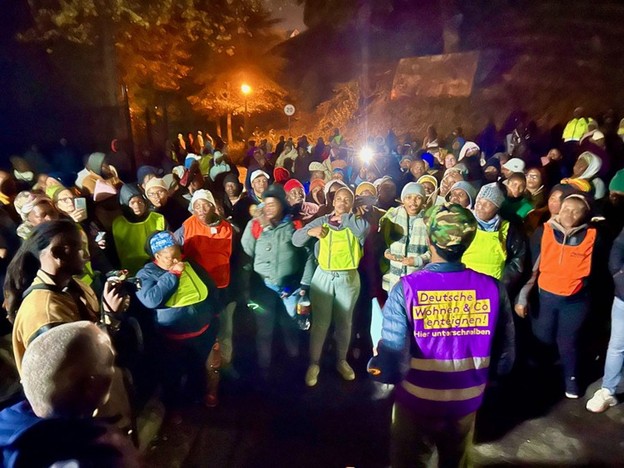

In this article, activists of the German movement “Deutsche Wohnen & co. Enteignen”- fighting for large scale expropriation of apartment buildings owned by private corporations in Berlin - report and reflect on a series of exchanges between them and South African movement Abahlali base Mjondolo and the NGO Ndifuna Ukwazi. The article describes discussions around expropriation in Germany and South Africa as well as the movements’ approaches to Internationalism. After an introduction, the paper begins with a description of the South African context, and the history, struggles and strategies of Abahlali base Mjondolo. This section is followed by a paralleloutlining of the German context, strategies and struggles of Deutsche Wohnen& co. Enteignen (known by its initials DWE). The third and final section provides an overview of the program of the exchanges in Berlin and Durban in 2024 and 2025and concludes with reflections on international solidarity, in theory and practice. Attached to this article is a recording of a public podium discussion held between, among others, activists of Deutsche Wohnen & Co. enteignen and Abahlali base Mjondolo as well as Ndifuna Ukwazi. The discussion took place at the end of September 2024 in Berlin during the first movement exchange. In it, the speakers discuss topics of. In the commentary section, the discussion is divided into topical segments, allowing listeners to select the sections that interest them most.
Introduction
“The forces of oppression are global and so too are the forces of resistance”.[1]
In an age where the opponent is global, anti-capitalist struggles can’t rely on local strategies only. This also applies to housing movements, even if their struggles are so specifically tied to local circumstances. Large, long-established housing movements like the Brazilian Landless Workers’ Movement (Movimento dos Trabalhadores Rurais SemTerra, MST) or South African Abahlali base Mjondolo (“those who live in shacks”, AbM) have therefore practiced international solidarity and collaboration with other movements for many decades.
As a comparatively young movement, Berlin’s Deutsche Wohnen & Co. enteignen (“Expropriate Deutsche Wohnen& Co.”; DWE), born in 2018, has begun to work on internationalist connections for some years now. There have been virtual and in-person exchanges with movements like the Los Angeles Tenants Union (LATU) or the Ireland wide Community Action Tenants Union (CATU), the afore mentioned MST and, most recently, South African movement Abahlali base Mjondolo. DWE has participated in the European Action Coalition's Housing Action Days and larger exchanges hosted by established European housing movements. While the movement’s connections have mostly grown from personal contacts between individual activists, parts of DWE are slowly establishing what are hoped to become long lasting structures of international exchange and solidarity.
The motivation for this exchange between DWE and AbM stems from the opportunity and necessity to learn from long-lasting movements like Abahlali as well as being able to build international solidarity as a tool for political pressure. Many stories about tenant solidarity could be written, but we believe a discussion of the relationship between DWE and Abahlali base Mjondolo is particularly interesting, as these movements are united by the struggle for redistribution of land and housing from below.
AbM and DWE organize in vastly different political, institutional, legal, and social contexts. Yet they share a fundamental perspective: access to land and housing is not a privilege, but a basic condition for a dignified life. Both movements understand housing as a key means of survival and contemporary legal and social concepts of land as 'property' as a fundamental element of social exclusion. This is why they strive for the redistribution of land and housing from those who seek to speculate and profit on it into communal property, democratically administered by those who inhabit it. Both AbM and DWE have succeeded in mobilizing segments of the population and fundamentally shifting political debates around property, housing, and land in South Africa and Germany respectively. Their deep commitment to democratic processes is reflected not only in existing organizational structures and modes of operation but also in their proposals for administering expropriated and communalized land and housing.
Pushed by a strikingly violent unwillingness of their states to act against dehumanizing housing systems, they thereby question one of the fundamental pillars of the capitalist system: private property. For this, they are met with discrediting media campaigns, state repression and harassment by political enemies. This is especially violent in the South African context, where Abahlali members have been the target of political assassinations and to this day, Abahlali counts 22 assassinated members. In the following sections, the history and strategy of both movements will be described in more detail.
Abahlali base Mjondolo – Land occupation as expropriation from below
Abahlali base Mjondolo is a self-described movement of shack dwellers that occupies vacant and unused land to build and provide housing, organizing under the slogan “land, housing, dignity.” Since its foundation in 2005, the movement has grown to include over150,000 members living in branches across five South African provinces. Through organized land occupations, communities of Abahlali members have created not only homes but “creches, halls, churches, and community gardens”[2],thereby effectively expropriating and communalizing the land from below.
Central to their struggle is the principle that the social value of land should take precedence over its commercial value–in other words land’s ‘use value’ over its ‘exchange value’–and that land should be recognized as a public good rather than a commodity. In pursuit of this principle, the movement is explicitly socialist, and its aims, approaches, and strategies are deeply informed by the values of Ubuntu philosophy[3] and Pan-Africanism[4],emphasizing collective responsibility, solidarity, and self-determination in the pursuit of housing and dignity for all.
The movement advocates for communal ownership of occupied land, calling for commonly held title deeds that would allow communities to manage their land through their own democratic structures. The intention is for the occupations to develop into “vibrant communes that develop social infrastructure, produce food and work towards other forms of production”. AbM aspires to develop along the lines of the Venezuelan commune model, in which neighbourhood councils federate into self-governing structures that collectively manage land, production, and infrastructure through democratic assemblies. Therefore, Abahlali branches are organized through democratic structures, featuring elected chairpersons, weekly assemblies, communally managed gardens, and systems of mutual aid. Taken together, this constitutes nothing less than a successful attempt at a collective reorganization of everyday life.
South African context and the discussion around expropriation
Like many other social movements and civil society organizations, Abahlali sees the root of the housing crisis in the failed resolution of the land issue during the “negotiated revolution” at the end of Apartheid. The 1996 constitution compromised on the land question, i.e. the restitution and redistribution of land violently stolen through colonialism and especially during the Apartheid Era, during which the majority Black population was systematically dispossessed of land. Although Apartheid was legally abolished, South Africa was declared the world’s most economically unequal country by the World Bank as recently as 2018. In the Land Audit Report on "Private Land Ownership by Race, Gender and Nationality” published in 2018 by the government’s Department of Rural Development and Land Reform, the distribution of land, i.e. farms and agricultural land, is concentrated to 72% in private ownership of white people, despite them making up merely 7.3% of the South African population. In stark contrast, within the black majority who makes up 81.4% of the population, ownership of land amounts to only 4 %.
The seizure of land and forced relocation of non-white residents from city centres partially to areas known as townships during Apartheid is widely understood as key for the presence of so-called spatial apartheid to this day. The term describes the geographical segregation and continued vast inequality in the distribution of resources, opportunity, infrastructure and land among different racial groups in South Africa. Spatial apartheid manifests, i.e., in the exclusion of especially black populations from living in the center of South African cities. Here, severe inequalities not only with regards to ownership, but even access to affordable housing and basic services around it. This leads to workers living outside of the centres spending significant proportions of their time and income on transportation.[5]
In contrast to Germany, significant portions of land are owned by the South African state. This is especially true for the province of KwaZulu-Natal, where Abahlali was founded and is most strongly represented. Here, around 50% of land is owned by the state. While it might be understood as an opportunity, many actors of civil society call attention to the failure of the state to properly utilize such land for public concerns as the building of social housing to try and tackle the housing crisis. Land owned by the state is rather often left vacant or rented to private businesses (e.g. golf courses) for extremely low annual fees. In such absence of the state, many see no alternatives to occupation, understanding it as a form f expropriation and redistribution from below.
A current and relevant example of institutionalized land reform in South Africa is the Expropriation Act of 2025, which allows for expropriation without compensation (EWC) when land is abandoned or held for speculative purposes. Previously, expropriation without compensation was not feasible. Similar to historical practices in Germany, the state could acquire land for public infrastructure, but compensation was required. The central argument for EWC, as it was brought back into the sphere of party politics by the EFF party in 2013, is that land stolen during colonialism and apartheid should not be bought back. More moderate approaches to expropriation, which argue for compensation, worry about maintaining economic and political stability and avoiding deterrence of investment in agriculture.
The legislative process for the Expropriation Act was long and provoked heated debates across South African society, whereby opinions on EWC often reflect racial and class divisions.[6] Ultimately signed into law by the president in January 2025, it drew international attention with intense outcomes, most notably being stated as the reason for Donald Trump to offer refugee status to white South Africans and threatening to suspend U.S. aid programs, worryingly affecting the Emergency Plan for AIDS Relief. South Africa’s left criticizes the Expropriation Act for being too narrow in scope, as it only addresses post-1913 dispossessions, neglecting earlier colonial-era land seizures. Moreover, it is considered insufficiently radical, failing to challenge dominant landholding patterns or enable broader land redistribution. For Abahlali, the Act’s limitations lie especially in the fact that it does not allow for communal ownership of expropriated land.[7] Abahlali rejects the idea that the state should own land on behalf of the people, seeing as “the state in its current form cannot be trusted”.[8] This position contrasts with other leftist voices, who advocate for total state ownership and custodianship of land.[9]
Strategies of Abahlali base Mjondolo
AbM employs a range of strategies to organize and empower shack-dwelling communities and challenge the ongoing legacies of spatial apartheid. One such strategy is occupying land located closer to the city enters or other sites of significant employment concentration when compared to most townships. This geographical proximity enables members to save time and money due to reduced transportation burdens. In these settlements, shack dwellers begin to create alternative forms of living in communally shared spaces to survive and build collective power.
A key principle of the organizing is the focus on communities rather than individuals. Abahlali encourages whoever is turning to them for support to mobilize their neighbours, addressing shared issues collectively. Once a community reaches 50 active members, Abahlali initiates its work there. This threshold is significant, as it is only with such numbers that communities can mount an effective defence against evictions and harassment by state actors and political enemies.
Central to the workings of Abahlali are structures like the political school, which provides political education and cultivates leadership, alongside dedicated structures such as the Women and Youth League, ensuring inclusive participation across generations and genders. The movement stresses the importance of their work as a political project rather than simple eviction relief, both to sustain motivation and to provide frameworks for conflict resolution within communities around a shared goal.
Alongside long-term political organizing, Abahlali works on short-term relief, fighting for the provision of basic services in settlements and ensuring immediate protections against evictions. Here, AbM engages with broader societal structures to protect the settlements. They actively engage the media to raise awareness, and use legal avenues and courts to defend communities against forced evictions. Most famously, Abahlali was successful in challenging the “Slums Act” of 2006, which’s objective was to eradicate shack settlements ahead of the 2010 FIFA World Cup hosted in South Africa.[10]
By challenging legacies of spatial apartheid and building alternative forms of power through direct action AbM has shown that communally organized land can enable residents to live more dignified lives. The longstanding legacy of this work creates examples for other movements who strive to build alternatives to contemporary speculative land regimes.
Deutsche Wohnen & Co. enteignen! [Expropriate Deutsche Wohnen and Company!]
Enteignen
Since 2018, under the banner of Deutsche Wohnen & Co. enteignen! (Expropriate Deutsche Wohnen and Company!) Berlin tenants have been working to expropriate and socialize over 200,000 apartments owned by the city’s largest landlords. Like its South African counterpart, DWE too is concerned with community control of land, as these socialized apartments would be controlled by their residents and not simply administered as social or public housing. Despite a successful referendum, where 59.1% of Berliners voted to ‘enteignen’[11], Berlin’s government has refused to act. DWE has argued that ‘enteignen’ is necessary due to the failure of existing rental regulations and failure to enforce existing regulations to curb rapid rental cost increases and displacement of residents. Enteignen as envisioned by the Berlin tenants that make up the DWE campaign, would make use of a constitutional clause (Article 15 of Germany’s basic law) that allows “Land, natural resources, and means of production may, for the purpose of socialization, be transferred to public ownership or into other forms of public enterprise”[12]. Importantly, DWE argues that enteignen could be done far below the speculatively inflated market value of these apartments. The control would be transferred from profit seeking landlords to the tenants of these buildings themselves, via legal entities–known in German as Anstalt des öffentlichenRechts (AöR)– and be controlled through tenant councils. The hope would be to create space for different ways of being, of living together via low housing costs and collective control.
Berlin context and the choice to ‘enteignen’
While at a different intensity, Berliners too have been struggling with rapidly increasing housing costs and displacement of lower-income households away from their workplaces to the city’s edges. Enteignen as a strategy responds to the state’s historic and ongoing role in facilitating speculation, its failure to adequately enforce existing regulations and failure to improve housing conditions for tenants. In the 1990s and 2000s the state sold over 200,000apartments at incredibly low-prices (approximately 20,000 euros each), to large real-estate concerns.[13] Since then, these homes have been treated as a simple financial asset by large firms such as Deutsche Wohnen & Co, Akelius, Heimstaden and Vonovia, who through sale and repurchase, merger, and acquisition have traded them back and forth employing whatever strategies possible to lower maintenance and service costs while steadily increasing rents. Since the introduction of reforms in the early2000s, housing still owned by the state companies has become more profit oriented, employing many of the same profit maximizing strategies of their privately owned or financialized equivalents.
Landlords often engage in regulatory evasion with the most recent examples being a rise in ‘medium-term’ furnished rentals—which allow landlords to charge higher rents and set term limits to the contracts—and the rapid growth in and proliferation of ‘eigenbedarf’ or own-use as a justification for eviction[14]. Own-use evictions are where landlords evict tenants because they want the use of an apartment, they own for themselves or a family member. Both medium-term rentals and Eigenbedarf evictions can be ‘legal’ (though are often misused) but represent ways to maximize profit or control over rental units to the detriment of long-term residents and renters. Large landlords tend to maximize profits by raising rents, increasing ‘nebenkosten’ (secondary costs such as heat), delaying maintenance and undermaintaining buildings and homes. Given the structure of Berlin’s rental regulations (most notably mietspiegel) large landlords can have a disproportionate impact on legal new rents. Enforcement tends to be difficult and mostly relies on tenants knowing their rights and being willing to sue their landlords.
Berlin’s government has introduced some regulatory policies to slow rent growth and displacement, with housing researcher Matthias Bernt characterizing the situation as representing an “arms race between investors and local administrations…”[15] one where local administrators have limited resources and where policies have not been adequate to halt rapidly growing housing costs. In 2020 the government introduced a rent cap (Mietendeckel) which briefly halted and reversed the growth in rental costs but was struck down by the German constitutional court on the basis that such a rule could only be implemented at the federal level (i.e. that of the German national government). Accordingly, for the Berliner tenants who make up the DWE campaign, there is a feeling that we must solve the housing problem ourselves, and a lack of trust a future Berlin government would not just once again privatize its state-owned housing hence the strategic decision to instead of re-municipalizing these homes to transfer their control collectively to their residents.
Historically expropriation in Germany has been associated with the state acting on behalf of private interests via projects such as autobahn or highway construction, land clearance for resource extraction or industry or dispossession of Jewish people by the National Socialist Regime.[16]Opponents of DWE have tried to instil fear by arguing that expropriation represents ‘a return to communism.’ And yet, despite these mostly negative associations with expropriation historically or by the campaign’s opponents, DWE has succeeded in popularizing expropriation. DWE has successfully made the case for an expropriation from below, or in other words an expropriation and socialization that is driven by and for Berlin tenants. This popularity is made clear by a proliferation of pro-expropriation graffiti and the emergence of expropriation campaigns elsewhere, including one focused on housing in Hamburg, and another aiming to expropriation a major energy company.[17] More broadly, academic research has documented a resurgence of discussion of socialization.[18]
The dual strategy for enteignen from below
In the first stage of the campaign (2018 to 2021) Berlin tenants set out to use primarily an electoral strategy –the successful referendum [Volksentscheid] of 2021– to demand that Berlin’s government, expropriate and socialize. Such a strategy involved mass mobilization, with thousands of Berliners collecting signatures, marching in the streets, and over a million voting in favour. Despite the successful result of the referendum, and the favourable results of the related expert commission which confirmed the legal validity of socialization via expropriation and the ability to compensate at below market value, the government has refused to act. This refusal to act is permissible in part because of a decision amongst DWE organizers to not initially launch a legally binding referendum. Berlin allows for two types of referenda, if the referendum is voting on a specific law or constitutional amendment it is legally binding. If the referendum does not have a specific law or constitutional amendment then it is a recommendation, though one that if ignored should generate high political costs for those ignoring it.
Given the ongoing failure of Berlin’s government to initiate expropriation or to take meaningful action to curb high housing costs Berlin tenants organizing through DWE have come to the realization that our strategy needed to evolve. Currently, the campaign is pursuing the dual strategy of writing our own law[19] to be voted on in a legally binding future referendum, and more broadly trying to build tenant power in the city through direct organizing of tenants especially those in apartments that are expropriation candidates (i.e. those owned by the city’s largest real estate companies).
DWE as a movement has amassed significant power and technical capacity that was not present when the movement launched in 2019. Notably, this increase in power and technical capacity has enabled DWE to write two laws, engaging with complex constitutional powers, that will be the centre of the second referendum to expropriate, and transfer these apartments to the collective control of their residents. The addition of direct organizing is essential in that it enables Berlin tenants via DWE to build tenant power to force the government to respond and respect the broader democratic will of the people. Further, by helping Berlin tenants who live in expropriation candidates (apartment buildings owned by Berlin’s largest private real estate companies) organize their buildings, tenants gain the power and capacity to make the decisions and take control of their homes. Having these skills and experiences will be invaluable as tenants work together in the structures that will be created with the results of a second successful referendum.
Practicing International Solidarity: Exchanges between Abahlali base Mjondolo and Deutsche Wohnen & Co. expropriate
In 2024, a transnational exchange began between activists from DWE and AbM, organized with the support of the Rosa Luxemburg Foundation in Berlin as well as its Southern Africa regional office. The focus was on the question of what international solidarity means in theory and practice. Activists from AbM and Ndifuna Ukwazi (NU) from South Africa travelled to Berlin to exchange experiences and perspectives on their respective housing and land struggles together with the DWE movement. Within the framework of workshops and events, the different contexts, challenges, and strategies of the movements were discussed, while at the same time common points of reference were developed. In two central workshops, the participants discussed both concrete forms of political organizing and possible paths for long-term, internationalist cooperation. Despite the different starting points, the two movements are united by what they have achieved in their respective local contexts: broad mobilization, collective organization, and political pressure, with the aim of fighting for access to land, housing, and a life in dignity.
While AbM and NU have long fought shoulder to shoulder in South Africa, this was the first official meeting between DWE, AbM, and NU in Berlin. What initially began within the circle of activists was made accessible to a wider public through a film screening and a panel discussion. Not only were the different strategies of political organizing discussed on the panel, but also global entanglements were made a topic. As Buhle Booi, an activist from NU, clearly emphasizes, one of the reasons for the poverty of South Africa's Black population lies in Berlin itself: 'The land issue is the legacy of apartheid, and apartheid is the legacy of the Berlin Conference of 1884. At that time, the international legal foundations for the colonial takeover of the continent were established. Before the colonizers came, there had been no private ownership, land was ancestral land, on which the local population lived collectively. With the drawing of borders by the invaders, the history of displacement and appropriation began.'
Pictures from the Podium
The first joint exchange of the movements in Berlin laid the foundation for continued collaboration. For this purpose, at the beginning of 2025, activists from DWE travelled to Durban, Cape Town, and Johannesburg. Within the framework of an international conference organized by the Habitat International Coalition (HIC), social movements and NGOs from various parts of the world met. Topics included, among others, land occupation, feminist approaches to the production of 'Social Habitat,' socialization, and generally access to a life in dignity. It quickly became clear that although the activists operate under different conditions, they pursue the common goal of building solidarity-based relationships and transforming material conditions in favour of oppressed populations. Outstanding in this regard was the recurring desire for safe and self-determined forms of living, contrary to a worsening precarization of living conditions worldwide.
In addition to AbM, in whose premises the conference took place, movements from Zimbabwe, Brazil, Cape Town, Kenya, and Gaza were also present. The highlight of the conference was participation in the demonstration organized by AbM for “Unfreedom Day." Together with thousands of people, the DWe activists took to the streets to support AbM’ s fight for "Land, Housing and Dignity" – and to draw attention to the fact that this is a global struggle for justice. As stated in a statement by AbM: "The forces of oppression are global and so too are the forces of resistance."[20]
Following this premise, the activists from DWe visited informal settlements, occupied houses, and held discussions with local organizers. At the center of the visits was the question of organization within the occupations. An example of this was the visit to the AbM Lindokuhle Mnguni occupation in Johannesburg, where the activists were invited to their weekly meeting. The meeting was led and moderated by the elected chairperson, while all residents had the opportunity to present and discuss their concerns and opinions regarding upcoming changes or structures within the occupation. This form of self-organization allows AbM and the residents to respond flexibly and collectively to internal conflicts or external threats. Transparency and participation are not abstract values, but simply a matter of survival for the occupation. Without clear structures and collective procedures, the occupation would be vulnerable– externally to the police and authorities, internally to tensions and overload.
In the subsequent discussion between the DWe activists and the residents, two questions were central: on the one hand, the question of the possibility of putting pressure on governments and local authorities to enforce the activists’ demands, and on the other hand, a possible development of counterpower, as political representatives in both Germany and South Africa do not act according to the will of the population. In conversations on the sidelines with individual members of AbM, another aspect also came up—the question of strategic alliances. Often, this involves very concrete, local alliances—for example with neighbouring companies that can provide certain infrastructure such as waste disposal or protection of the occupation. Alliances that are vital for survival in the short term but do not always fit into a larger political project. This too represents a tension familiar to many movements: balancing immediate necessity and long-term strategy. Central points that also arose during the visit to the Cissi Gool House in Cape Town. The Cissi Gool House serves as a utopian beacon for many housing movements. It is a hospital that has been occupied since 2018 and has been empty, which has now successfully served for more than seven years as a home for many homeless families.
Picture: Cissi Gool House
Here a meeting took place with one of the long-term residents and community leaders, Bevel Lucas, as well as interactions with residents and security personnel. It became clear how the occupation itself has created self-managed, collective structures – structures that are continuously confronted with both internal and external contradictions. On the one hand, it is about the transformative conflict resolution approaches practiced in the house, which try to get by as much as possible without state interventions (for example through the police). Instead, there is an attempt to involve all participants in order to enable and establish bottom-up conflict resolutions. On the other hand, the entire house is surrounded by a fence, which is guarded by municipal security. Officially for the protection of the residents, yet it is at the same time a symbol of their criminalization and isolation from the neighbourhood. During the guided tour through the house, it becomes clear that this is an ongoing struggle for recognition and maintenance. Constant renovations are needed to keep the former hospital intact and habitable, a task that residents usually have to take on themselves, even when suitable materials are lacking. Bavel describes how support and rejection alternate in the neighbourhood—a reflection of the precarious conditions under which political organizing takes place.
For many residents, the Cissi Gool House, like other occupied houses in Cape Town, primarily represents the possibility of secure accommodation. But as with the AbM's occupation, another component is also central here: the occupation as apolitical project. Bringing these together is not always straightforward, according to Bevil. Some residents of occupied houses do not want to participate politically. Either due to a lack of politicization, or quite simply out of being overwhelmed. Here, a central aspect of political self-organization becomes apparent: How can people be politicized beyond immediate need and the fight for dignified housing be embedded in larger social struggles, so that residents not only participate in the preservation of the building but also become part of a movement. Involving people in movements and new forms of coexistence in the long term is a challenge that stretches from Cape Town to Berlin. The occupation of the Woodstock Hospital relies on embedding the residents' fight into a general struggle against gentrification for the politicization of residents. The former working-class neighbourhood became, at the latest after 2007, when the Cape Town City Council designated the area as a priority urban development zone for city renovations, an investment bubble.
This was accompanied by significant tax breaks that attracted wealthy local and foreign developers and investors[21].A development against which the residents of the Cissi Gool House resisted. The occupation is therefore not merely about housing; it is about the right to the city, it is about helping shape the place where people build a home, it is about a struggle from below, which is part of an occupiers' movement that stretches from Cape Town through London to Berlin[22].The energy emanating from this occupation not only exerts an impressive radiance for house battles worldwide; the forms of organization provide insightful impulses for future administrative practices of expropriated houses in Berlin. Specifically, this means the joint management of common areas, collective gardening, events in the house, and general assemblies in which further projects are decided. It means repeatedly transforming the efforts of self-administration into shared hope. It also shows how important networking into the neighbourhood is to counteract the urban logic of criminalizing leftist housing projects and to build broad support for self-administration.
The Tension Field of Global Solidarity: Impulses from Exchange
But what are the common struggles, starting from such different conditions? Activists in South Africa and Germany are united by resistance against displacement, exclusion, and violence, which manifest in the lack of access to dignified housing. In Berlin, rental dynamics push people to the edges of the city and into homelessness, while in South African metropolises like Durban or Cape Town, large parts of the poor population have no access to inner-city housing. In both contexts, racialized and economically marginalized groups are displaced from the centres—they keep the cities running, but remain socially and spatially excluded.
Particularly formative for the activists from Berlin was the encounter with 'practical utopias' such as the Cissi Gool House in Cape Town or the Lindokuhle Mnguni occupation in Johannesburg. These places show how another city can be shaped from below, as self-managed, collective structures that remove living space from the logic of the market and instead focus on communal use, mutual support, and political organization. A practice that DWe still has ahead of it, once the housing corporations in Berlin are expropriated and could thus be used as a blueprint for all of Germany. At the same time, this presents the initiative with the challenge of self-management and the further expansion of the movement.
But the parallels have limits. In South Africa, the struggle for land and housing is inextricably linked to the history of colonial dispossession and apartheid. These differences also shape the exchange between the movements. When white activists travel from Germany to South Africa to show solidarity, it becomes apparent not only a common opposition to global property relations, but also how complex international solidarity is in practice, as it is often accompanied by expectations that are difficult to implement. For example, the question regularly arose as to how activists from DWe can concretely change the living conditions in the land occupations. A task that individual activists find difficult to fulfil, as the strategy is not based on individual support, but on collective, international organizing between movements.
The question therefore arises: How can Germany contribute to actually combating the global unequal distribution of wealth, beyond symbolic gestures or moral indignation?
Initial indications of how international solidarity can gradually develop and take shape were discussed in the conversations between the activists from AbM and DWE. AbM brought in various possibilities based on their experience over the past decades. In acute cases of repression or violent displacement of the movement, what is needed is pressure from the international community on South African politics. Methods such as open letters, public solidarity, or demonstrations in front of South African embassies serve this purpose. In the long term, with international networking, skill-sharing is particularly relevant: exchanging successful strategies, methods, and victories, but also struggles that did not work, defeats, and what can be learned from them. An exchange that learns from its local conditions and provides international knowledge. Furthermore, among the activists, there is the plan for regular virtual discussions and further in-person meetings to enable long-term skill-sharing. On the basis laid by the exchange and the personal contacts that have been strengthened, regular collaboration can succeed in the coming years. The experiences of the exchange also confirm a simple, consequential truth: solidarity is easier when people meet in person.
It cannot be denied that building solidarity-based relational structures is something that is not always easy, and that virtual meetings cannot replace them. The question of how to organize together effectively across nations, governments, and differences, without falling into charitable solidarity structures, remains a learning process. It is the attempt at collective learning to find access to strategically meaningful relationships. It remains important to stay connected in order to form joint alliances at the right moment, which bring us closer toa life in dignity and break up property relations. The likely driving force from the exchange and the building of international structures is the realization that there are movements worldwide fighting for the same goals.
This gives rise to the motivation to continue the local struggles, in the knowledge of global solidarity. But also the realization that solidarity is only the beginning. A collectively supported internationalism is not a random collection of individual struggles. It is "the practical organized consequence of a shared analysis of global conditions." Whether proletarian internationalism in the 19th century, the Communist International, anti-colonial movements, or the anti-globalization movement of the 2000s, it was always the shared realization of a global connection of exploitation that enabled collective capacity for action[23].Solidarity can only be transformative if it acknowledges its own entanglement in both global and local exploitative relations—and fights against inequality not just elsewhere, but simultaneously here and there[24].
Conclusion
Abahlali base Mjondolo and Deutsche Wohnen & co enteigen are both working towards the socialization of property. And because South Africa and Germany are marked by social, political, cultural and economic differences, AbM and DWE make use of different tactics and legal frameworks, operate on different scales and have enabled different material realities. Despite this, these two movements have begun to try and find ways of building on existing solidarity. The exchanges in Berlin and in Durban, Cape Town and Johannesburg described here represent some of the ways activists from these two movements have tried to make this solidarity concrete. While this solidarity remains primarily in broadening imaginaries and exchanging tactics, as members of DWE we know our movement has already greatly benefited from these exchanges.
Understanding how others live and fight for better worlds is essential. Internationalism is difficult, requires substantial efforts and may not reap immediate benefits. Nonetheless, it remains essential. We must know that other ways of fighting and living are possible, that things can be different. Our hope is that exchanges, be they with AbM or other tenant, land and labour movements, enable collective fightback against the contemporary context which encourages violent dispossession of land and home in the name of speculative profit making. As a movement we will continue to work towards making the benefits of internationalism concrete, and build communities of solidarity across borders and contexts.
[1]https://peoplesdispatch.org/2025/04/25/abahlali-basemjondolo-marks-20-years-of-defiant-struggle-on-unfreedom-day/
[2] cf. in https://abahlali.org/node/17023/
[3] Ubuntu philosophy is often described as “humanism”, emphasizing interconnectedness and mutual care, the idea that one’s humanity is realized through others and in community, cf. Gill, Gerhard, in Abahlali base Mjondolo, Interface 6 (1) 2014, 211-229, 217.
[4] Pan-Africanism is a term that includes varying positions and ideas that share the aim of a unified Africa, for all Africans or people of African descent. Social movements as Abahlali understand Pan-Africanism as a radical movement, “driven from below, with a vision of a united and free Africa in which wealth and resources are shared and people’s dignity restored”, cf. https://abahlali.org/node/17121/
[5] as impressively depicted in the video “Two sides of the same city”, by Ndifuna Ukwazi, https://www.youtube.com/watch?v=CpKno__zaZg
[6] Zenker O, Walker C., Beyond Expropriation Without Compensation: Law, Land Reform and the Future of Redistributive Justice in South Africa. In: Zenker O, Walker C, Boggenpoel Z-Z,(eds). Beyond Expropriation Without Compensation: Law, Land Reform and Redistributive Justice in South Africa, Cambridge University Press; 2024,3-32, 14.
[7] https://abahlali.org/node/17025/
[8] Zandile Nsibande, co-founder of Abahlali base Mjondolo, in “South Africa’s Black Working Class Opposes the Land Reform Law That Led Donald Trump to Give White People Refugee Status”, Hammer&Hope Magazine, No. 6 (Spring 2025).
[9] eg. the position of the EFF, cf. “Frequently asked questions on Land Expropriation without compensation”, https://effonline.org/wp-content/uploads/2024/01/FAQ-2020.pdf.pdf.pdf
[10]
[11] Here we follow Higgins, C. & Kerrigan, D. ‘Enteignen. in Madeleine Hamlin &Carlos Declos Eds. Housing Justice: A Lexicon for Building Solidarity. Oakland.PM Press: 2026. 106-114. 106-107. in using enteignen to mean both expropriation and socialization
[12] Drohsel,F., Rohner, C., Fried, B., & Kuhn, A. ‘What Can Article 15 Do?’Socialization is not only popular, but as far as the German constitution is concerned – perfectly legal. Rosa Luxemburg Foundation. 2026.
[13] Aalbers MB, Holm A. Privatising social housing in Europe: The cases of Amsterdam and Berlin. Urban trends in Berlin and Amsterdam. 2008. 1;110:12-23.
[14] White, T. The strange loophole that transformed Berlin from tenant’s paradise to a landlord’s playground. The Guardian. 2025. January 22. Retrieved from:https://www.theguardian.com/commentisfree/2025/jan/22/berlin-housing-crisis-germany-rents-flats
[15] Bernt M. The commodification gap: gentrification and public policy in London, Berlin and St. Petersburg. John Wiley & Sons; 2022: 174
[16] VollmerL, Gutiérrez D. Organizing for expropriation. How a tenants campaign convinced Berliners to vote for expropriating big landlords. Radical Housing Journal. 2022;4(2):47-66. 48.
[17] Higgins & Kerrigan, 2026:
[18] Berfelde, R., & Blumenfeld, J. (2024). Von der Vergesellschaftung zurPlanung und wieder zurück: Über alte und neue Debatten um Wirtschaftsplanungund Vergesellschaftung. PROKLA. Zeitschrift für kritische Sozialwissenschaft,54(215), 177-193.
[19] https://dwenteignen.de/unser-gesetz
[20] https://peoplesdispatch.org/2025/04/25/abahlali-basemjondolo-marks-20-years-of-defiant-struggle-on-unfreedom-day/
[21] Joseph, R. The gentrification of Woodstock: from rundown suburb to hipster heaven. The Guardian. 2014. August 12. Retrieved from:
https://www.theguardian.com/cities/2014/aug/12/gentrification-woodstock-cape-town-suburb-hipster-heaven
[22] Petersen, K. The Fight for Affordable Housing: The Story of Cissie Gool House, https://capetown.today/the-fight-for-affordable-housing-the-story-of-cissie-gool-house/
[23] Timo Dorsch, in: Solidarität – einereale Utopie, hrsg. von Mia Neuhaus, Lucas Mielke und Massimo Perinelli(Berlin: Verbrecher Verlag, 2025), S. 15
[24] ibid.:154.
.png)

