From Genocide to Green Hydrogen: Historical Justice and Energy Transition in Ancestral Nama Territories

By
Andrea Pietrafesa, Anne Schroeter

From Genocide to Green Hydrogen: Historical Justice and Energy Transition in Ancestral Nama Territories

Andrea Pietrafesa, Anne Schroeter
10 Apr 2026
No items found.
From Genocide to Green Hydrogen: Historical Justice and Energy Transition in Ancestral Nama Territories
No items found.
No items found.

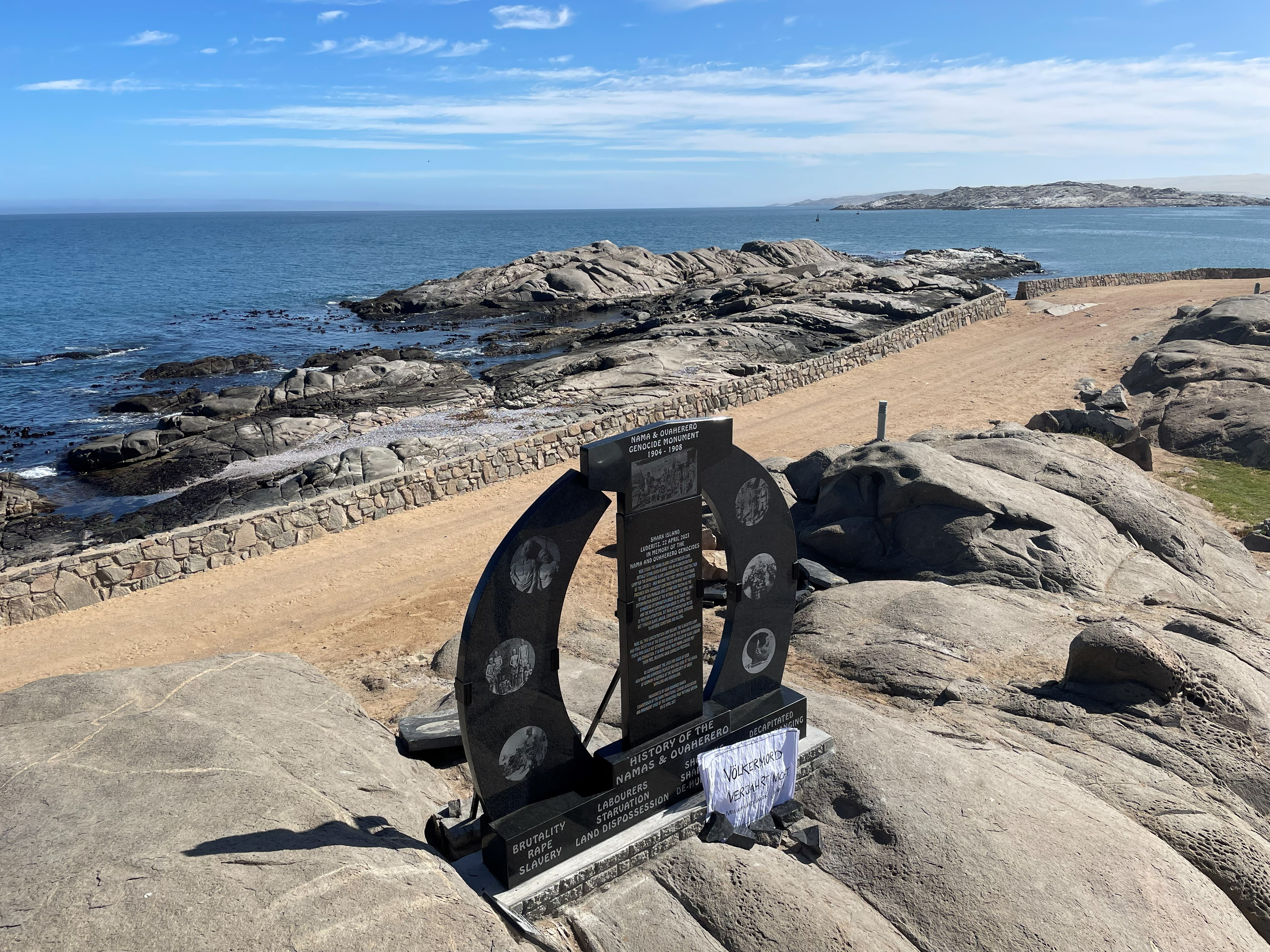
A memorial site erected by the Ovaherero and Nama on Shark Island, the site of a former concentration camp during the genocide perpetrated by German colonial troops near Lüderitz © ECCHR.

How is the German colonial genocide and territorial dispossession of the Nama people connected to the current renewable energy projects in Namibia? This analysis examines how unresolved historical disputes over land, reparations for genocide and colonialism, and the right to self-determination are resurfacing today in the context of the energy transition. The planned green hydrogen project “Hyphen” shows that, without historical justice and territorial rights, energy transition policies reproduce colonial practices and perpetuate old narratives of occupation while justifying capitalist expansion and exploitation in new ways. Regarding current energy issues as separate from genocide and its ongoing effects ignores the history of the indigenous Nama people, who survived colonial crimes by the German Empire. These are not separate issues, as the impact of each falls on the same land and the same communities.

Introduction: History, Territory, and a Recurring Debate

In southern Namibia, contemporary debates over renewable energy and a just transition are taking place on territory marked by a history of colonial violence, forced displacement, and political exclusion. To understand current controversies surrounding the Hyphen green hydrogen project in Tsau||Khaeb National Park, it is necessary to go back several centuries and examine the historical relationship between the Nama people and their land as well as the ruptures caused by German colonial occupation and genocide in the early twentieth century.

The Nama people historically inhabited a vast area known as Great Namaqualand, which extends from the Fish River Canyon to the Atlantic coast in areas of present-day southern Namibia and part of South Africa. Since at least the fourteenth or fifteenth century, these territories have been used seasonally for grazing in a continuous network of movement between summer and winter pastures. Nama communal life was based on goat herding, hunting, detailed knowledge of water sources — springs, rivers, and wells — and the use of medicinal plants and minerals.

Starting in 1652, European colonial expansion from the Cape gradually pushed the Nama northward toward the Orange River. In the eighteenth century, Nama leaders like Jakobous Fredericks consolidated settlements such as Khouigandis, now known as Bethanie, establishing political, agricultural, and technical structures that strengthened Nama territorial control. This order was violently interrupted by German colonization, which reached its darkest period between 1904 and 1908 when the German Schutztruppe (protection force) and settlers committed the first genocide of the twentieth century against the Nama and Ovaherero peoples. The genocide and associated crimes exterminated 50 percent of the Nama population, many of them killed on Shark Island, where the Germans maintained a concentration camp between 1905 and 1908.

Genocide, Colonial Spatial Reorganization, and Contemporary Inequality

The genocide perpetrated by the German Empire was not limited to military violence. It included a profound reorganization of land, economy, and access to resources. Large areas were transformed into farms for European settlers, exploited by German colonial companies through mining concessions, and closed off through exclusion zones. One of the most significant was the so-called Sperrgebiet (restricted area), which was created in 1908 to protect German diamond mining interests and meant the expulsion of the indigenous Nama populations.

This territorial regime did not disappear with the end of German colonial rule in the area. The restricted area was maintained throughout the twentieth century with concessions granted to other mining activities before it was eventually converted into the current Tsau||Khaeb National Park in 2008. Although the area was renamed and is now presented as a conservation area, the fundamental principle of indigenous exclusion remains intact. Surviving Nama communities and their descendants have never regained control or access to these territories, despite their deep historical and cultural connection to them.

Tsau||Khaeb National Park spans roughly 26,000 square kilometres with an Atlantic coastline of roughly 600 km. Of this coastline, only a limited area of 50–60 square kilometres around the town of Lüderitz, including Shark Island and Angra Point, are publicly accessible. The remaining coastline and park is inaccessible to the Nama people and the public – however, mining and tourism concessions remain active.

The effects of structural dispossession remain visible in present-day Namibia. Historical and legal records document how indigenous access to land was progressively restricted through fraudulent treaties, forced removals, establishment of “native reserves”, and administrative measures. These policies laid the foundation for a deeply unequal political economy in which Nama communities were — and are to the present day — marginalized and excluded from land and from the material means to sustain autonomous lives.

Today, this history explains why many Nama communities continue to face high levels of economic precarity and dependence on informal labour. Nevertheless, the Nama people retain political organizational structures and capacities inherited from their ancestors who survived the genocide, which has enabled a string of political mobilizations in response to decisions affecting their territories. Land restitution and territorial recognition remain politically sensitive issues in Namibia, despite their centrality to historical justice.

Between 2015 and 2021, the German and Namibian governments negotiated a reconciliation agreement, the so-called “Joint Declaration”, which recognizes Germany’s historic responsibility for the genocide and commits to supporting the Namibian government with development aid worth 1.1 billion EUR over a period of 30 years. From the beginning of these negotiations, Nama and Ovaherero descendants of the victims of the genocide and other colonial crimes demanded direct participation in the negotiations, reparations, and acknowledgement of the genocide by the German government not just from a historical point of view, but also legally. Nama and Ovaherero descendants, together with civil society actors in Germany, have advocated for strengthening the rights of victims of international crimes, including when they were committed during colonialism, and for general awareness in Germany of its own colonial past and atrocities.

Energy Transition and New Forms of Extractivism: Renewable Energy Projects Threaten Biodiversity Hot Spots in Ancestral Nama Land

It is against this backdrop that current green hydrogen and renewable energy projects have emerged in Great Namaqualand. The Hyphen project seeks to construct and operate a green hydrogen facility that will export ammonia worldwide. Hyphen Ltd. is a company registered in Namibia with shares held by the German renewable energy company ENERTRAG SE and the British investment firm Nicholas Holdings Ltd. The German government is supporting this project by considering granting it the status of a strategic foreign project. This would facilitate access to funding as well as provide support for the Namibian government in setting up regulatory frameworks and other infrastructure that would be necessary for the country to enter the hydrogen market and export ammonia.

Hyphen Ltd.’s infrastructure is being developed across a 4,000 square kilometre area in Tsau||Khaeb National Park, and it includes solar plants, wind parks, desalination plants, electrolysis and ammonia storage facilities, and associated infrastructure needed to operate and maintain the project.

Tsau||Khaeb National Park is a site of exceptional global importance. It contains 90 percent of Namibia’s Succulent Karoo Biome — the world’s only arid biodiversity hotspot and one of just 36 biodiversity hotspots globally. These ecosystems not only harbour extraordinary levels of endemism but also contribute to carbon storage and climate regulation. As emphasized by the Namibian Chamber of Environment, large-scale hydrogen development threatens one of the last near-pristine arid wilderness areas on Earth.

Despite clearly defined protection zones in the Park Management Plan, hydrogen concession areas were allocated without regard for these safeguards. Even areas categorized as having “lower” conservation status are known to support levels of biodiversity and endemism beyond those of many European protected areas. In this extremely fragile desert environment, ecological restoration is exceptionally difficult, and plant translocation frequently fails. Any large-scale industrial disturbance would therefore cause irreversible damage that cannot realistically be offset elsewhere. The proposed Hyphen project must be assessed in light of these permanent ecological risks.

The impact would not be limited to terrestrial ecosystems. Hyphen Ltd. is proposing major industrial infrastructure at Angra Point — the only publicly accessible section of the coastline — to serve as an ammonia export terminal. The peninsula is a key biodiversity area that provides a habitat for endangered seabirds, migratory wetland birds, whales, dolphins, Cape fur seals, and brown hyenas.

Angra Point is also located within the Benguela Upwelling System, one of the world’s most productive yet environmentally sensitive marine regions. This coastline is shaped by cold, nutrient-rich upwelling, persistent fog, strong winds, and episodic low-oxygen events. While these conditions sustain remarkable biological productivity, they also render the ecosystem highly vulnerable to additional stress.

Further compounding these risks are the planned desalination plants. For every litre of freshwater produced, approximately 1.5 litres of heated, hypersaline brine mixed with chemical residues are generated. When discharged into the ocean, this dense effluent can settle on the seabed, suffocating marine organisms and jeopardizing small-scale fisheries and oyster enterprises.

Taken together, the extensive infrastructure required for Hyphen’s hydrogen project poses severe and irreversible threats to terrestrial, coastal, and marine ecosystems. At the same time, it risks compounding long-standing injustices experienced by the Nama people.

Environmental Racism: Neocolonial Extractivism and Human Rights

Promoted as part of an energy transition necessary to address the climate crisis, this project (falsely) promises investment, employment, and economic growth for Namibia. However, for many Nama communities, it also evokes continuities with the past. As highlighted, the territory designated for the Hyphen project is not “empty” or “neutral” land available for development and exploitation. It is an ecosystem of deep historical and cultural significance for the Nama people, including a desert and coastal areas of global ecological significance classified as biodiversity hotspots.

The combination of declaring land a national park for the purpose of environmental conservation, foreign investment by the former colonizers, and “green development” narratives while excluding the indigenous land owners reproduces a colonial logic familiar to the Nama and indigenous peoples more generally: decisions made without their meaningful participation as economic and other material benefits are concentrated outside their territory and people and social costs are borne by indigenous communities and local residents. Presenting the hydrogen project as “green” and sustainable ignores the impacts on cultural heritage and the indigenous rights of Nama communities. This pattern is frequently observed in modern extractive projects: green transition narratives overshadow historical justice, silently reproducing exclusion under the guise of sustainable development.

From a political-economic perspective, the key question arises: can the energy transition be just if it is built on land dispossession that was never addressed? Without land restitution and territorial recognition, the green transition risks becoming a new phase of colonialism, now legitimized by the language of sustainable development.

Addressing Colonial Continuities and Resisting “Green” Extractivism

Since April 2025, the Nama Traditional Leaders Association (NTLA), together with the European Center for Constitutional and Human Rights (ECCHR), Forensic Architecture (FA), the Society for Threatened Peoples (STP), and the Minority Rights Group International (MRG), has undertaken advocacy to highlight violations of Nama Indigenous rights and the Hyphen project’s wide-ranging impacts. These efforts seek to enforce the Nama’s right to be consulted and to give or withhold free, prior, and informed consent (FPIC) for developments on their ancestral lands, in line with human rights and environmental standards and the principles of a just energy transition.

In September 2025, the German energy giant RWE terminated its memorandum of understanding to purchase ammonia from Hyphen Ltd. for export to Europe. This followed a letter sent on 2 April 2025 (later made public) and an intervention at RWE’s Annual General Meeting on 30 April 2025 urging the company to withdraw until the Nama’s right to FPIC and environmental rights are fully respected.

In October 2025, the UN Committee on Economic, Social and Cultural Rights included in Germany’s 2026 periodic review specific questions on its extraterritorial obligations related to hydrogen production abroad. These address:

1. Measures to secure FPIC of Indigenous peoples affected by green energy projects on ancestral lands and

2. Steps to prevent violations of the right to a healthy environment and to biodiversity arising from German-backed green energy projects or companies operating overseas.

These issues were added following a June 2025 submission by NTLA, ECCHR, STP, MRG, and FA, and an ECCHR intervention before the committee in Geneva in September 2025. Unfortunately, the eightieth session of the committee has been indefinitely postponed due to the UN’s funding crisis, and a new timeline for Germany’s review is uncertain.

On 19 November 2025, after meeting with Surya Deva, the UN Special Rapporteur on the Right to Development, he issued preliminary findings from his official visit to Germany. He emphasized that renewable energy projects “within or beyond Germany” must not bypass human rights and environmental safeguards, stating that “renewable energy should also be responsible energy”. He cited the green hydrogen project in Great Namaqualand as a key example, noting the absence of FPIC and risks to cultural rights and biodiversity.

Looking Forward: A Just and Decolonial Transition

Events and developments in Nama territory show that climate justice and historical justice are deeply intertwined. A truly just energy transition cannot be limited to reducing emissions and attracting (foreign) investment. It must address structural inequalities inherited from colonialism and recognize indigenous communities as rights-holders. Such projects cannot come at their cost and must include them.

In this case, this includes, among other measures, fully acknowledging the genocide and its consequences, securing land restitution, ensuring effective participation of Indigenous and other affected communities, and linking climate policies to processes of truth, memory, and reparations. Ultimately, the situation faced by the Nama people reminds us that decisions about energy and ecosystems are not just technical or economic. They are profoundly political decisions that reflect the ways that societies confront their past and determine who has the right to make decisions about the future.

About the authors:

Andrea Pietrafesa: ecofeminist collective Sur Territoria, former legal advisor at the European Center for Constitutional and Human Rights

Anne Schroeter: European Center for Constitutional and Human Rights

Share this post

From Genocide to Green Hydrogen: Historical Justice and Energy Transition in Ancestral Nama Territories

Andrea Pietrafesa, Anne Schroeter
10 Apr 2026
No items found.
From Genocide to Green Hydrogen: Historical Justice and Energy Transition in Ancestral Nama Territories
No items found.
No items found.

A memorial site erected by the Ovaherero and Nama on Shark Island, the site of a former concentration camp during the genocide perpetrated by German colonial troops near Lüderitz © ECCHR.

How is the German colonial genocide and territorial dispossession of the Nama people connected to the current renewable energy projects in Namibia? This analysis examines how unresolved historical disputes over land, reparations for genocide and colonialism, and the right to self-determination are resurfacing today in the context of the energy transition. The planned green hydrogen project “Hyphen” shows that, without historical justice and territorial rights, energy transition policies reproduce colonial practices and perpetuate old narratives of occupation while justifying capitalist expansion and exploitation in new ways. Regarding current energy issues as separate from genocide and its ongoing effects ignores the history of the indigenous Nama people, who survived colonial crimes by the German Empire. These are not separate issues, as the impact of each falls on the same land and the same communities.

Introduction: History, Territory, and a Recurring Debate

In southern Namibia, contemporary debates over renewable energy and a just transition are taking place on territory marked by a history of colonial violence, forced displacement, and political exclusion. To understand current controversies surrounding the Hyphen green hydrogen project in Tsau||Khaeb National Park, it is necessary to go back several centuries and examine the historical relationship between the Nama people and their land as well as the ruptures caused by German colonial occupation and genocide in the early twentieth century.

The Nama people historically inhabited a vast area known as Great Namaqualand, which extends from the Fish River Canyon to the Atlantic coast in areas of present-day southern Namibia and part of South Africa. Since at least the fourteenth or fifteenth century, these territories have been used seasonally for grazing in a continuous network of movement between summer and winter pastures. Nama communal life was based on goat herding, hunting, detailed knowledge of water sources — springs, rivers, and wells — and the use of medicinal plants and minerals.

Starting in 1652, European colonial expansion from the Cape gradually pushed the Nama northward toward the Orange River. In the eighteenth century, Nama leaders like Jakobous Fredericks consolidated settlements such as Khouigandis, now known as Bethanie, establishing political, agricultural, and technical structures that strengthened Nama territorial control. This order was violently interrupted by German colonization, which reached its darkest period between 1904 and 1908 when the German Schutztruppe (protection force) and settlers committed the first genocide of the twentieth century against the Nama and Ovaherero peoples. The genocide and associated crimes exterminated 50 percent of the Nama population, many of them killed on Shark Island, where the Germans maintained a concentration camp between 1905 and 1908.

Genocide, Colonial Spatial Reorganization, and Contemporary Inequality

The genocide perpetrated by the German Empire was not limited to military violence. It included a profound reorganization of land, economy, and access to resources. Large areas were transformed into farms for European settlers, exploited by German colonial companies through mining concessions, and closed off through exclusion zones. One of the most significant was the so-called Sperrgebiet (restricted area), which was created in 1908 to protect German diamond mining interests and meant the expulsion of the indigenous Nama populations.

This territorial regime did not disappear with the end of German colonial rule in the area. The restricted area was maintained throughout the twentieth century with concessions granted to other mining activities before it was eventually converted into the current Tsau||Khaeb National Park in 2008. Although the area was renamed and is now presented as a conservation area, the fundamental principle of indigenous exclusion remains intact. Surviving Nama communities and their descendants have never regained control or access to these territories, despite their deep historical and cultural connection to them.

Tsau||Khaeb National Park spans roughly 26,000 square kilometres with an Atlantic coastline of roughly 600 km. Of this coastline, only a limited area of 50–60 square kilometres around the town of Lüderitz, including Shark Island and Angra Point, are publicly accessible. The remaining coastline and park is inaccessible to the Nama people and the public – however, mining and tourism concessions remain active.

The effects of structural dispossession remain visible in present-day Namibia. Historical and legal records document how indigenous access to land was progressively restricted through fraudulent treaties, forced removals, establishment of “native reserves”, and administrative measures. These policies laid the foundation for a deeply unequal political economy in which Nama communities were — and are to the present day — marginalized and excluded from land and from the material means to sustain autonomous lives.

Today, this history explains why many Nama communities continue to face high levels of economic precarity and dependence on informal labour. Nevertheless, the Nama people retain political organizational structures and capacities inherited from their ancestors who survived the genocide, which has enabled a string of political mobilizations in response to decisions affecting their territories. Land restitution and territorial recognition remain politically sensitive issues in Namibia, despite their centrality to historical justice.

Between 2015 and 2021, the German and Namibian governments negotiated a reconciliation agreement, the so-called “Joint Declaration”, which recognizes Germany’s historic responsibility for the genocide and commits to supporting the Namibian government with development aid worth 1.1 billion EUR over a period of 30 years. From the beginning of these negotiations, Nama and Ovaherero descendants of the victims of the genocide and other colonial crimes demanded direct participation in the negotiations, reparations, and acknowledgement of the genocide by the German government not just from a historical point of view, but also legally. Nama and Ovaherero descendants, together with civil society actors in Germany, have advocated for strengthening the rights of victims of international crimes, including when they were committed during colonialism, and for general awareness in Germany of its own colonial past and atrocities.

Energy Transition and New Forms of Extractivism: Renewable Energy Projects Threaten Biodiversity Hot Spots in Ancestral Nama Land

It is against this backdrop that current green hydrogen and renewable energy projects have emerged in Great Namaqualand. The Hyphen project seeks to construct and operate a green hydrogen facility that will export ammonia worldwide. Hyphen Ltd. is a company registered in Namibia with shares held by the German renewable energy company ENERTRAG SE and the British investment firm Nicholas Holdings Ltd. The German government is supporting this project by considering granting it the status of a strategic foreign project. This would facilitate access to funding as well as provide support for the Namibian government in setting up regulatory frameworks and other infrastructure that would be necessary for the country to enter the hydrogen market and export ammonia.

Hyphen Ltd.’s infrastructure is being developed across a 4,000 square kilometre area in Tsau||Khaeb National Park, and it includes solar plants, wind parks, desalination plants, electrolysis and ammonia storage facilities, and associated infrastructure needed to operate and maintain the project.

Tsau||Khaeb National Park is a site of exceptional global importance. It contains 90 percent of Namibia’s Succulent Karoo Biome — the world’s only arid biodiversity hotspot and one of just 36 biodiversity hotspots globally. These ecosystems not only harbour extraordinary levels of endemism but also contribute to carbon storage and climate regulation. As emphasized by the Namibian Chamber of Environment, large-scale hydrogen development threatens one of the last near-pristine arid wilderness areas on Earth.

Despite clearly defined protection zones in the Park Management Plan, hydrogen concession areas were allocated without regard for these safeguards. Even areas categorized as having “lower” conservation status are known to support levels of biodiversity and endemism beyond those of many European protected areas. In this extremely fragile desert environment, ecological restoration is exceptionally difficult, and plant translocation frequently fails. Any large-scale industrial disturbance would therefore cause irreversible damage that cannot realistically be offset elsewhere. The proposed Hyphen project must be assessed in light of these permanent ecological risks.

The impact would not be limited to terrestrial ecosystems. Hyphen Ltd. is proposing major industrial infrastructure at Angra Point — the only publicly accessible section of the coastline — to serve as an ammonia export terminal. The peninsula is a key biodiversity area that provides a habitat for endangered seabirds, migratory wetland birds, whales, dolphins, Cape fur seals, and brown hyenas.

Angra Point is also located within the Benguela Upwelling System, one of the world’s most productive yet environmentally sensitive marine regions. This coastline is shaped by cold, nutrient-rich upwelling, persistent fog, strong winds, and episodic low-oxygen events. While these conditions sustain remarkable biological productivity, they also render the ecosystem highly vulnerable to additional stress.

Further compounding these risks are the planned desalination plants. For every litre of freshwater produced, approximately 1.5 litres of heated, hypersaline brine mixed with chemical residues are generated. When discharged into the ocean, this dense effluent can settle on the seabed, suffocating marine organisms and jeopardizing small-scale fisheries and oyster enterprises.

Taken together, the extensive infrastructure required for Hyphen’s hydrogen project poses severe and irreversible threats to terrestrial, coastal, and marine ecosystems. At the same time, it risks compounding long-standing injustices experienced by the Nama people.

Environmental Racism: Neocolonial Extractivism and Human Rights

Promoted as part of an energy transition necessary to address the climate crisis, this project (falsely) promises investment, employment, and economic growth for Namibia. However, for many Nama communities, it also evokes continuities with the past. As highlighted, the territory designated for the Hyphen project is not “empty” or “neutral” land available for development and exploitation. It is an ecosystem of deep historical and cultural significance for the Nama people, including a desert and coastal areas of global ecological significance classified as biodiversity hotspots.

The combination of declaring land a national park for the purpose of environmental conservation, foreign investment by the former colonizers, and “green development” narratives while excluding the indigenous land owners reproduces a colonial logic familiar to the Nama and indigenous peoples more generally: decisions made without their meaningful participation as economic and other material benefits are concentrated outside their territory and people and social costs are borne by indigenous communities and local residents. Presenting the hydrogen project as “green” and sustainable ignores the impacts on cultural heritage and the indigenous rights of Nama communities. This pattern is frequently observed in modern extractive projects: green transition narratives overshadow historical justice, silently reproducing exclusion under the guise of sustainable development.

From a political-economic perspective, the key question arises: can the energy transition be just if it is built on land dispossession that was never addressed? Without land restitution and territorial recognition, the green transition risks becoming a new phase of colonialism, now legitimized by the language of sustainable development.

Addressing Colonial Continuities and Resisting “Green” Extractivism

Since April 2025, the Nama Traditional Leaders Association (NTLA), together with the European Center for Constitutional and Human Rights (ECCHR), Forensic Architecture (FA), the Society for Threatened Peoples (STP), and the Minority Rights Group International (MRG), has undertaken advocacy to highlight violations of Nama Indigenous rights and the Hyphen project’s wide-ranging impacts. These efforts seek to enforce the Nama’s right to be consulted and to give or withhold free, prior, and informed consent (FPIC) for developments on their ancestral lands, in line with human rights and environmental standards and the principles of a just energy transition.

In September 2025, the German energy giant RWE terminated its memorandum of understanding to purchase ammonia from Hyphen Ltd. for export to Europe. This followed a letter sent on 2 April 2025 (later made public) and an intervention at RWE’s Annual General Meeting on 30 April 2025 urging the company to withdraw until the Nama’s right to FPIC and environmental rights are fully respected.

In October 2025, the UN Committee on Economic, Social and Cultural Rights included in Germany’s 2026 periodic review specific questions on its extraterritorial obligations related to hydrogen production abroad. These address:

1. Measures to secure FPIC of Indigenous peoples affected by green energy projects on ancestral lands and

2. Steps to prevent violations of the right to a healthy environment and to biodiversity arising from German-backed green energy projects or companies operating overseas.

These issues were added following a June 2025 submission by NTLA, ECCHR, STP, MRG, and FA, and an ECCHR intervention before the committee in Geneva in September 2025. Unfortunately, the eightieth session of the committee has been indefinitely postponed due to the UN’s funding crisis, and a new timeline for Germany’s review is uncertain.

On 19 November 2025, after meeting with Surya Deva, the UN Special Rapporteur on the Right to Development, he issued preliminary findings from his official visit to Germany. He emphasized that renewable energy projects “within or beyond Germany” must not bypass human rights and environmental safeguards, stating that “renewable energy should also be responsible energy”. He cited the green hydrogen project in Great Namaqualand as a key example, noting the absence of FPIC and risks to cultural rights and biodiversity.

Looking Forward: A Just and Decolonial Transition

Events and developments in Nama territory show that climate justice and historical justice are deeply intertwined. A truly just energy transition cannot be limited to reducing emissions and attracting (foreign) investment. It must address structural inequalities inherited from colonialism and recognize indigenous communities as rights-holders. Such projects cannot come at their cost and must include them.

In this case, this includes, among other measures, fully acknowledging the genocide and its consequences, securing land restitution, ensuring effective participation of Indigenous and other affected communities, and linking climate policies to processes of truth, memory, and reparations. Ultimately, the situation faced by the Nama people reminds us that decisions about energy and ecosystems are not just technical or economic. They are profoundly political decisions that reflect the ways that societies confront their past and determine who has the right to make decisions about the future.

About the authors:

Andrea Pietrafesa: ecofeminist collective Sur Territoria, former legal advisor at the European Center for Constitutional and Human Rights

Anne Schroeter: European Center for Constitutional and Human Rights

Share this post